
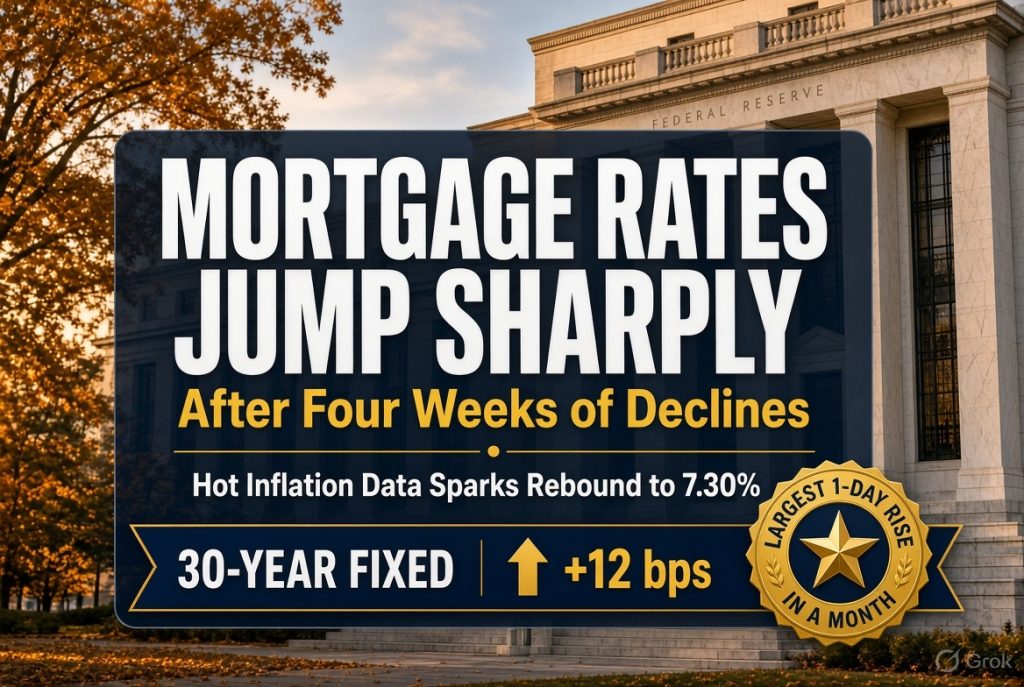
The brief period of relief in mortgage rates came to an abrupt end this week. After declining for four consecutive weeks, the average rate on the 30-year fixed mortgage jumped sharply higher following a hotter-than-expected inflation report.
According to Mortgage News Daily, the average 30-year fixed rate rose 12 basis points from Monday to 7.30% on Tuesday — the largest single-day increase in more than a month. The move erased much of the recent progress that had brought rates to their lowest level since mid-September.
What drove the jump
The catalyst was the latest Consumer Price Index release, which showed broader upward pressure on prices beyond just energy costs. The data followed a stronger-than-expected employment report the previous Friday, reinforcing the picture of an economy that remains more resilient — and more inflationary — than many had anticipated.
Markets interpreted the combination as reducing the likelihood of near-term rate cuts from the Federal Reserve. The central bank has recently emphasized that inflation remains its primary concern, and the latest figures supported a more cautious stance.
The short-lived relief and its impact
Prior to this week’s rebound, rates had been easing. The Mortgage Bankers Association reported that the average 30-year fixed rate for loans with 20% down fell to 7.21% last week, the fourth straight weekly decline. That improvement helped lift total mortgage applications by 6.2% week-over-week. Purchase applications rose 8%, while refinance applications increased 5%.
Even so, activity remains well below year-ago levels. Purchase applications were still down 18% compared with the same week in 2025, and refinance volume remained sharply lower.
What it means for buyers and the housing market
The sudden reverse highlights how sensitive mortgage rates remain to incoming economic data. For prospective homebuyers, the four-week decline had offered a modest window of improved affordability and prompted some to re-enter the market. The latest spike closes that window, at least temporarily, and is likely to keep many would-be purchasers on the sidelines.
Builders and sellers already navigating elevated inventory and cautious demand now face another headwind. Unless inflation cools more convincingly in the coming months, mortgage rates appear set to remain volatile and elevated, prolonging the challenging environment for housing activity.